-1024x1024.webp)
-1-1024x1024.webp)
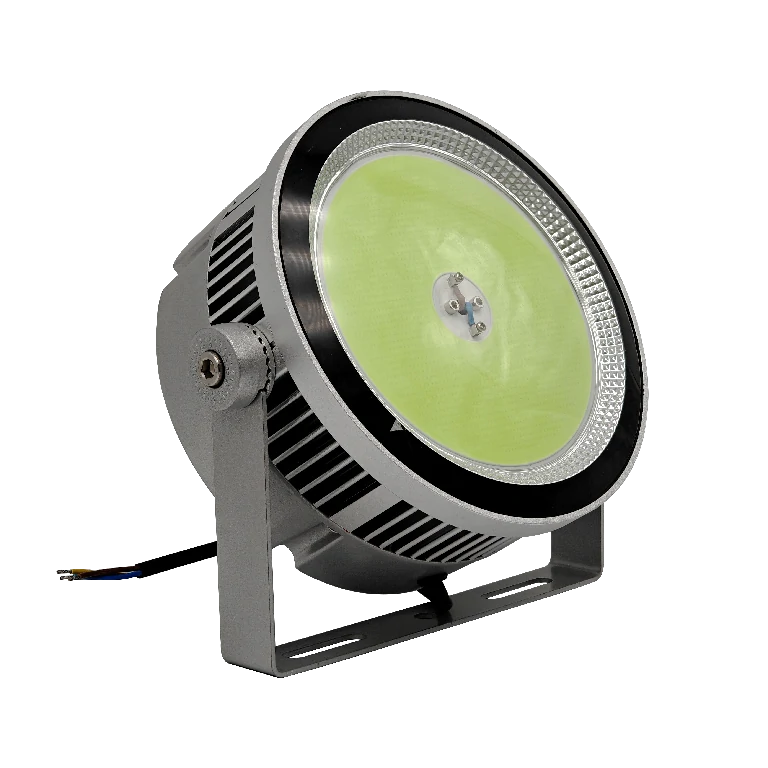
When designing a high-power commercial fishing light, choosing the right LED technology is just as important as selecting the correct light color. While many people focus on whether a fishing light emits green, blue, or red light, professional manufacturers also pay close attention to how that color is produced. This is especially true for red fishing lights, where two different technologies are commonly used: phosphor-converted red LEDs (PC Red) and native red LED chips.
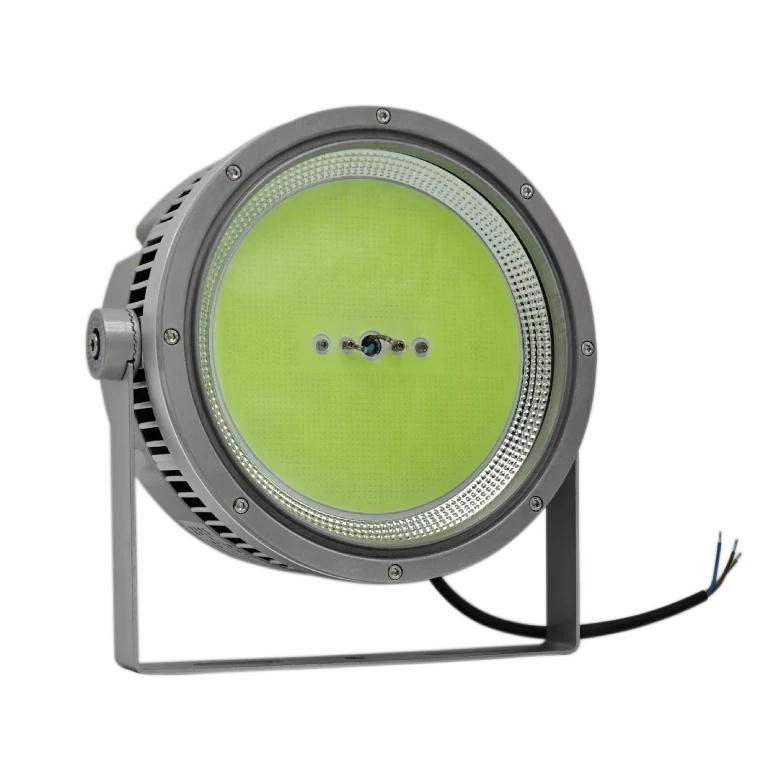
At first glance, both technologies produce red light, making them appear nearly identical in practical use. However, once the power level reaches hundreds or even thousands of watts—as is common in commercial underwater fishing lights—the differences become much more significant. Chip material, thermal performance, optical efficiency, manufacturing cost, and long-term reliability can all directly affect the final performance of the fishing light.
This raises a common question among buyers, engineers, and commercial fishing operators: Which technology is actually better for high-power fishing lights? Some people assume that native red LEDs must always be the better choice because they produce a purer red wavelength. Others believe phosphor-converted red LEDs are simply a lower-cost alternative. In reality, the answer is far more technical than it appears.
In commercial fishing, the goal of a red fishing light is not to attract fish over a long distance. Instead, red light is mainly used during the netting stage to help stabilize fish schools, reduce stress responses, and minimize sudden escape behavior while the catch is being harvested. To achieve this consistently, the lighting system must maintain stable light output even under high power and long operating hours. This is where the choice of LED technology becomes critically important.
In this guide, we’ll compare phosphor-converted red LEDs and native red LED chips from an engineering perspective. Instead of focusing only on chip price, we’ll examine the factors that truly matter in commercial fishing lights, including manufacturing cost, thermal droop, optical performance, cooling requirements, long-term reliability, and real-world fishing applications. By the end of this article, you’ll understand why most high-power commercial fishing lights are designed around phosphor-converted red LED technology.
What Is the Difference Between Phosphor Red and Native Red LEDs?
Although both technologies produce red light, they generate it in completely different ways. Understanding this difference is the key to explaining why their performance varies so much in high-power commercial fishing lights.
Native Red LEDs: Producing Red Light Directly
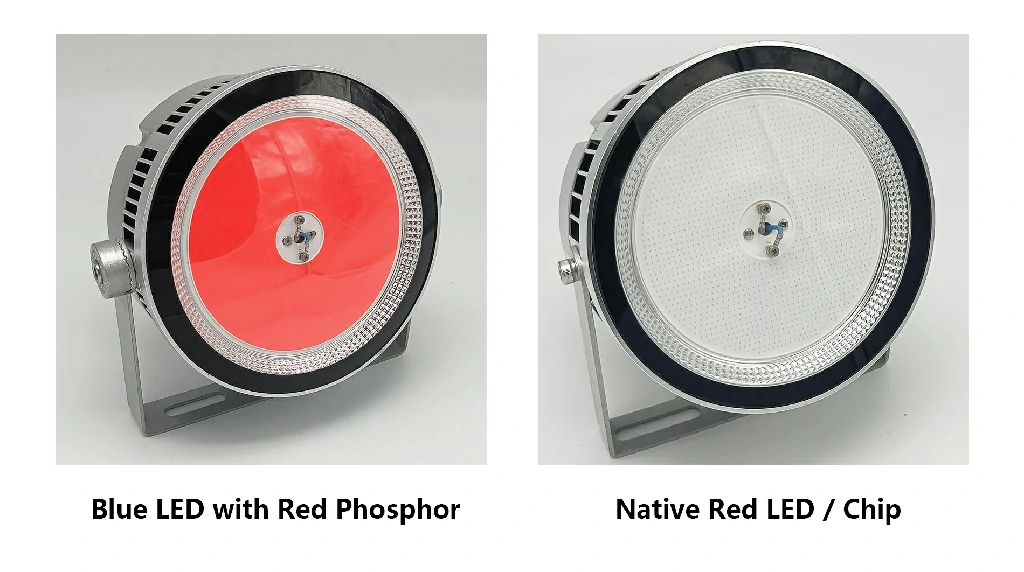
Native red LEDs generate red light directly from the semiconductor chip itself. Most high-quality native red chips are manufactured using AlInGaP (Aluminum Indium Gallium Phosphide), a semiconductor material specifically designed to emit red wavelengths.
Because the chip itself produces red light, the emitted wavelength is relatively pure and concentrated. This is why native red LEDs are commonly found in applications such as traffic signals, indicator lights, automotive lighting, and display systems where accurate color reproduction is important.
However, this technology also has a significant limitation. AlInGaP chips are highly sensitive to temperature. As the junction temperature rises, their luminous efficiency drops rapidly—a phenomenon known throughout the LED industry as thermal droop. In high-power applications, this reduction in light output can become substantial if thermal management is not carefully controlled.
Phosphor-Converted Red LEDs: Creating Red Light Through Conversion
Phosphor-converted red LEDs use a completely different approach. Instead of producing red light directly, they start with a highly efficient blue LED chip. Part of the blue light then passes through a specially formulated red phosphor layer, which converts a portion of the blue energy into red wavelengths. The final output appears as red light.
This technology is similar to the way many modern white LEDs are manufactured. Instead of relying on a naturally red-emitting semiconductor, it takes advantage of the excellent efficiency, mature manufacturing process, and outstanding thermal performance of blue LED chips.
As a result, phosphor-converted red LEDs generally maintain more stable optical performance under high-power operation, making them particularly suitable for commercial fishing lights that operate continuously for long periods.
The Difference Is More Than Just Color
At first glance, both technologies produce similar red light, and the difference may not be obvious to the human eye. However, for commercial fishing lights operating at 500W, 1000W, or even several kilowatts, the choice of LED technology affects far more than color.
It influences luminous efficiency, thermal droop, cooling system design, chip quantity, manufacturing cost, long-term reliability, and overall system performance. In other words, selecting the right LED technology is not simply about achieving the desired color—it is about building a fishing light that can deliver stable performance throughout thousands of hours of operation.
Why Native Red LEDs Become Extremely Expensive in High-Power Fishing Lights
Many people assume that native red LEDs are more expensive simply because the LED chips themselves cost more. While this is true, the chip price is only part of the story. For high-power commercial fishing lights, the largest cost increase comes from the entire lighting system rather than the LED package alone.
The Biggest Challenge Is Thermal Droop
The biggest weakness of native red LEDs is thermal droop.
Unlike blue LED chips, native red chips are highly sensitive to junction temperature. As the LED becomes hotter during operation, its luminous efficiency decreases rapidly. In some high-power applications, the light output can drop by 30% to 50% as the junction temperature rises. At the same time, the emitted wavelength may shift toward a longer red wavelength, reducing optical consistency.
This means the LED not only becomes less efficient but also produces less usable light while consuming nearly the same electrical power.
More Heat Means More Hardware
To maintain the same brightness, manufacturers cannot simply increase the drive current. Doing so would generate even more heat, accelerating thermal droop and shortening the LED’s service life.
Instead, engineers usually have only two practical solutions.
The first is to install a much larger cooling system, including bigger heat sinks, improved thermal interfaces, or more advanced structural designs to keep the junction temperature under control.
The second is to use a larger number of LED chips, allowing each chip to operate at a lower current. Although this reduces heat generation per chip, it also increases material cost, PCB size, assembly complexity, and driver design requirements.
Why the Total System Cost Increases
This is why native red LED fishing lights become significantly more expensive as power increases.
The additional cost does not come from a single component. It comes from every part of the lighting system working together to overcome thermal droop.
Manufacturers may need more LED chips, larger aluminum heat sinks, stronger structural components, higher-performance thermal materials, and more complex electronic drivers. Every improvement adds cost, weight, and manufacturing complexity.
For a commercial fishing light operating continuously at 1000W, 2000W, or even higher power levels, these costs become substantial.
Why Phosphor-Converted Red LEDs Have an Advantage
Phosphor-converted red LEDs start with highly efficient blue LED chips, which have much better thermal characteristics than native red chips.
Because blue LEDs experience significantly less thermal droop, the lighting system can maintain more stable light output even during long operating hours. This reduces the need for oversized cooling systems and excessive chip counts, resulting in a simpler, more cost-effective design.
For commercial fishing light manufacturers, this means achieving stable performance with lower overall system cost rather than simply reducing chip cost.
Performance Comparison: Phosphor Red vs Native Red LEDs
Choosing between phosphor-converted red LEDs and native red LEDs is not simply a matter of selecting a chip. For commercial fishing light manufacturers, the decision affects manufacturing cost, long-term reliability, thermal management, and overall system performance.
The comparison below highlights the key differences between the two technologies in high-power commercial fishing lights.
| Feature | Phosphor-Converted Red LED | Native Red LED |
| LED Technology | Blue LED + Red Phosphor | Native AlInGaP Red Chip |
| Chip Cost | Lower | Significantly Higher |
| Thermal Droop | Low | Severe |
| High-Temperature Lumen Maintenance | Excellent | Poor |
| Cooling Requirement | Moderate | High |
| Wavelength Stability | Stable | More Sensitive to Temperature |
| Overall System Cost | Lower | Much Higher |
| Recommended Power Range | Medium to Ultra High Power | Low to Medium Power |
| Best Application | Commercial Fishing Lights | Specialty Lighting & Low-Power Applications |
Thermal Droop Is the Turning Point
Among all the differences, thermal droop has the greatest impact on high-power fishing lights.
As operating temperature rises, native red LEDs lose luminous efficiency much faster than phosphor-converted red LEDs. This means the lighting system must work harder just to maintain the same usable light output.
For commercial fishing vessels that often operate continuously throughout the night, stable optical performance is far more valuable than achieving the purest possible red wavelength.
Lower Chip Cost Does Not Mean Lower Quality
Some buyers mistakenly believe that phosphor-converted red LEDs are simply a low-cost substitute for native red LEDs.
In reality, they represent a different engineering solution.
Instead of relying on a temperature-sensitive red semiconductor, phosphor-converted red LEDs utilize the mature performance of blue LED technology to achieve better efficiency and long-term stability under demanding operating conditions.
For high-power commercial fishing lights, this often results in better overall system performance rather than simply reducing manufacturing cost.
Engineering Decisions Are Based on System Performance
When engineers develop commercial fishing lights, they rarely evaluate a single component in isolation.
Instead, they consider how every component works together.
If one LED technology requires a larger heat sink, more LED chips, a more powerful driver, and a heavier housing, the entire product becomes more expensive to manufacture, transport, and maintain.
This is why professional manufacturers focus on overall system efficiency rather than the performance of an individual LED chip.
Which LED Technology Is Better for Commercial Fishing Lights?
For commercial fishing lights, the answer is not determined by which LED technology produces the “purest” red light. Instead, the real question is which technology can deliver stable optical performance, long operating life, and lower overall system cost under continuous high-power operation.
Stable Red Light Is More Important Than Pure Red Light
The primary role of a red fishing light is different from that of green or blue fishing lights.
Rather than attracting fish from long distances, red fishing lights are mainly used during the netting stage to help stabilize fish schools, reduce stress response, and minimize escape behavior while the catch is being lifted.
Because of this, maintaining consistent red light output throughout the harvesting process is more important than producing an extremely narrow or pure red wavelength.
Why Professional Manufacturers Prefer Phosphor-Converted Red LEDs
For high-power commercial fishing lights, phosphor-converted red LEDs offer several practical advantages.
Because they are built on mature blue LED technology, they experience significantly less thermal droop during continuous operation. This allows the lighting system to maintain more consistent brightness over long working hours while reducing cooling requirements and overall manufacturing cost.
For fishing vessels operating throughout the night, this combination of stability, efficiency, and reliability is often more valuable than achieving the purest possible red wavelength.
Native Red LEDs Still Have Their Place
This does not mean native red LEDs are an inferior technology.
In applications where precise wavelength control or high color purity is required—such as indicator lights, display systems, and certain specialized lighting products—native red LEDs remain an excellent solution.
However, commercial fishing lights have a very different set of engineering priorities. Long operating hours, high power levels, thermal management, durability, and total system cost all play a much larger role in determining the best LED technology.
The Best Choice Depends on the Application
There is no single LED technology that is superior in every application.
However, when the goal is to build reliable commercial fishing lights operating at high power for extended periods, phosphor-converted red LEDs provide a more balanced engineering solution by combining stable optical performance, lower thermal sensitivity, and reduced overall system cost.
This is one of the main reasons why phosphor-converted red LEDs have become the preferred choice for many modern high-power commercial fishing light manufacturers.
Final Verdict: Which Red LED Technology Should You Choose?
If you’re designing or purchasing a high-power commercial fishing light, phosphor-converted red LEDs are generally the more practical choice.
While native red LEDs can produce highly pure red wavelengths, their severe thermal droop makes them difficult and expensive to use in high-power systems. As operating temperature rises, maintaining stable brightness requires larger cooling systems, more LED chips, and higher overall manufacturing costs.
Phosphor-converted red LEDs take a different approach. By using mature blue LED technology combined with red phosphors, they deliver more stable light output, lower thermal sensitivity, and better overall system efficiency during continuous operation.
For commercial fishing vessels that operate for long hours at high power, these engineering advantages often outweigh the benefits of wavelength purity.
Myth vs. Fact
Myth: Native red LEDs always perform better because they produce a purer red wavelength.
Fact: Wavelength purity is only one factor. In high-power commercial fishing lights, long-term optical stability, thermal performance, cooling requirements, and overall system cost have a much greater impact on real-world performance.
Myth: Phosphor-converted red LEDs are only used because they are cheaper.
Fact: Lower chip cost is only part of the reason. Their lower thermal droop allows engineers to design more efficient, reliable, and cost-effective high-power fishing lights.
Myth: A purer red wavelength always results in better fishing performance.
Fact: In commercial fishing, red lights are primarily used during netting operations to stabilize fish schools and reduce escape behavior. Stable light output throughout the harvesting process is generally more important than achieving the purest possible red wavelength.
Frequently Asked Questions
Why are native red LED chips more expensive?
Native red LEDs use AlInGaP semiconductor materials and require more complex thermal management in high-power systems, resulting in significantly higher chip and overall system costs.
Do phosphor-converted red LEDs reduce fishing performance?
No. For commercial fishing lights, the primary function of red light is to stabilize fish schools during netting operations rather than attract fish over long distances. As long as the lighting system provides stable and reliable red light, fishing performance is not determined solely by the LED technology.
Which technology is better for high-power commercial fishing lights?
For high-power commercial fishing lights operating continuously for long periods, phosphor-converted red LEDs generally provide a better balance of thermal performance, reliability, manufacturing cost, and overall system efficiency.