-1024x1024.webp)

Introduction: Why Light Plays an Important Role in Squid Fishing
Squid fishing is one of the most fascinating examples of how biology and fishing technology work together. For centuries, fishermen have observed that squid become more active around artificial light at night. Today, commercial squid fishing vessels use advanced fishing lights to influence squid movement, concentrate fishing areas, and improve harvesting efficiency.
However, squid are not attracted to light simply because they “like brightness”. Their response to light is the result of millions of years of evolution. Their unique living habits, highly sensitive eyes, and hunting behavior all influence how they react to different light conditions.
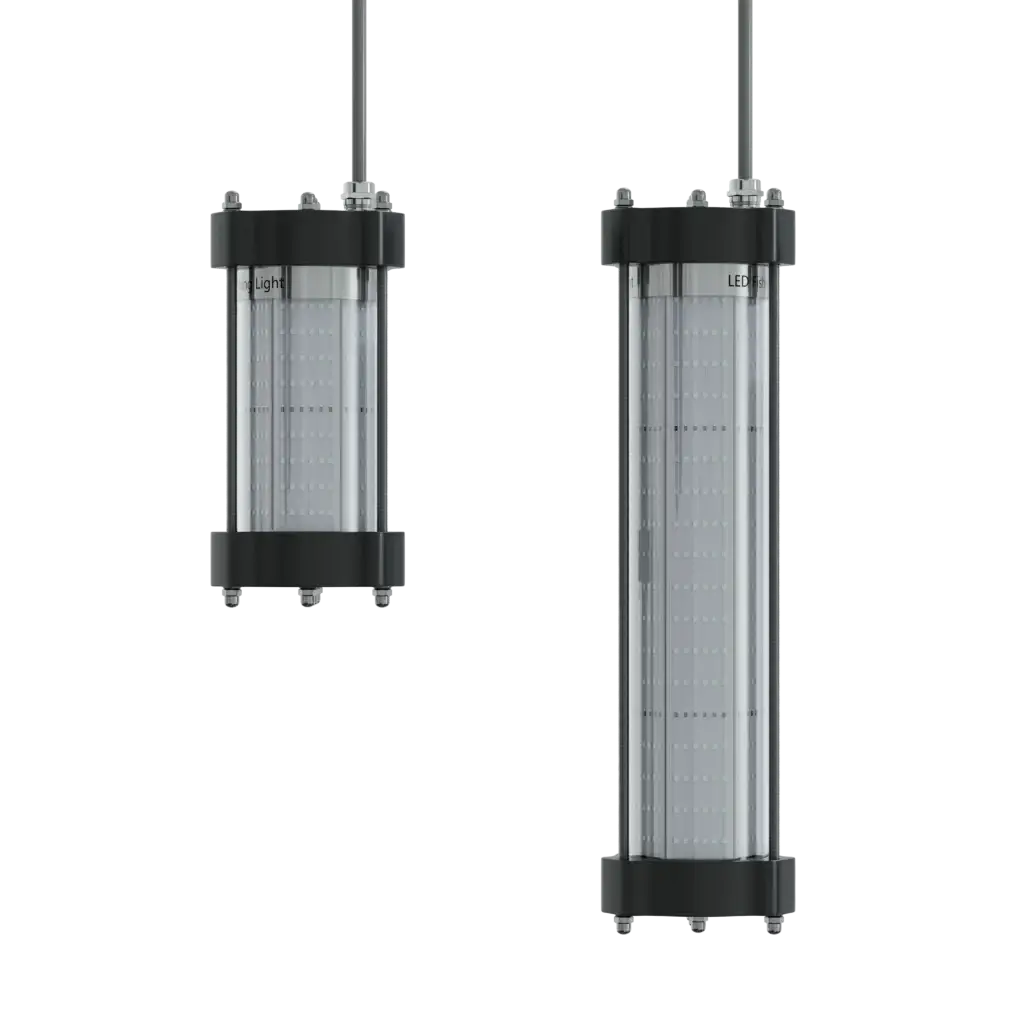
Understanding why squid are attracted to light is important for choosing the right squid fishing light. Different fishing operations may use different solutions, including underwater fishing lights and squid fishing boat lights, depending on water depth, target species, and fishing methods.
This article explains the science behind squid phototaxis, how squid eyes detect light, how LED wavelengths influence their behavior, and how modern fishermen use light for squid fishing.
Squid Living Habits: Why Are Squid Active at Night?
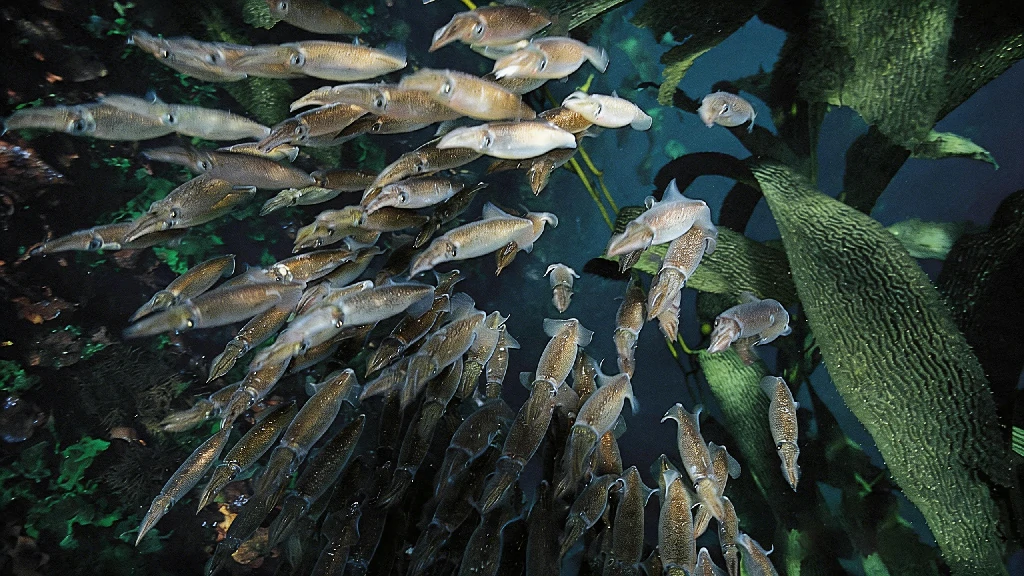
Most commercially important squid species live in offshore marine environments and spend their lives moving between different water layers. During daylight hours, many squid remain in deeper areas where light intensity is lower. This behavior helps them avoid predators and maintain suitable living conditions.
At night, when natural sunlight disappears, squid often migrate upward to search for food. Their diet mainly includes small fish, shrimp, and other marine organisms. This vertical movement between deep water and shallow water is one of the main reasons why squid fishing is usually carried out at night.
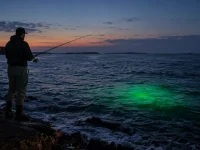
Commercial fishermen take advantage of this natural behavior by creating artificial light environments around fishing vessels. The purpose of a squid fishing light is not to directly force squid to approach, but to influence their natural movement through visual stimulation and food-chain effects.
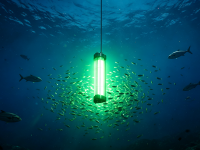
When fishing lights are turned on, the light can attract plankton and small marine organisms. These smaller organisms may then attract baitfish, creating a feeding environment that encourages squid to move closer to the fishing area.
This natural chain reaction is the basic principle behind many commercial squid fishing operations.
Squid Phototaxis: Why Do Squid Move Toward Artificial Light?
Phototaxis refers to the movement response of animals toward or away from a light source. Many marine organisms show phototactic behavior because light is closely connected with feeding, reproduction, and survival.
For squid, light is an important environmental signal. In the dark ocean, changes in brightness can indicate the presence of biological activity, such as plankton and small fish. Their sensitive visual system allows them to detect these changes and respond accordingly.
However, squid phototaxis is not as simple as “brighter light attracts more squid”. Their response depends on many factors, including light wavelength, intensity, location, water depth, and the surrounding environment.
This is why professional squid fishing operations carefully design their lighting systems instead of using only the strongest possible light source.
Squid Eye Structure: Why Squid Can Detect Light in the Dark Ocean
One of the most important reasons why squid respond strongly to fishing lights is their highly developed visual system. Unlike many marine animals that rely mainly on other senses, squid depend heavily on their eyes to hunt, avoid predators, and navigate through changing ocean environments.
The ocean is a challenging visual environment. As depth increases, natural sunlight is gradually absorbed by seawater, and only a limited amount of light can reach deeper areas. To survive under these conditions, squid have evolved large and sensitive eyes that can capture very weak light signals.
Compared with human eyes, squid eyes are specially adapted for detecting movement and contrast in low-light environments. This ability allows squid to locate prey and respond quickly even during nighttime hunting.
The Structure of Squid Eyes and Their Adaptation to Low Light
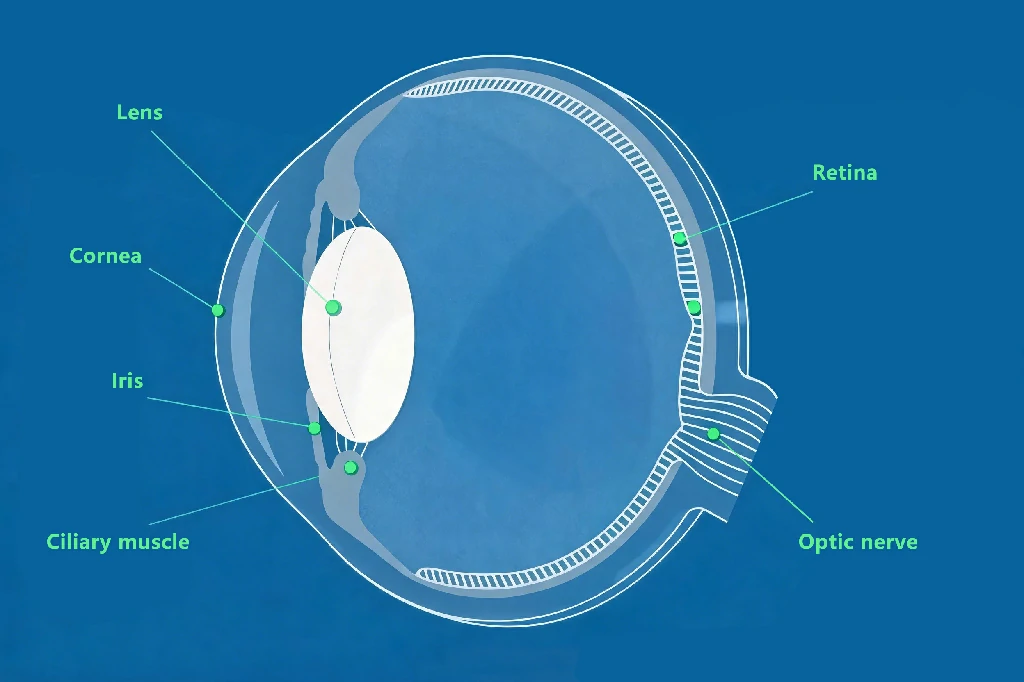
The squid eye has a complex structure that is similar to a camera system. It contains several important parts, including the lens, retina, and photoreceptor cells, which work together to capture and process visual information.
Unlike humans, squid have evolved their eyes for survival in the underwater world. Their vision is not mainly designed for seeing a wide range of colors, but for detecting changes in brightness, movement, and shapes in a dark environment.
For commercial squid fishing, this visual characteristic is extremely important. LED squid fishing lights work by providing specific light signals that interact with the squid’s natural vision system.
The Role of the Retina in Squid Light Detection
The retina is one of the most important parts of the squid eye. It contains a large number of photoreceptor cells that convert incoming light into electrical signals, allowing the squid brain to understand visual information.
A special feature of squid retina is the high density of rod cells. These cells are extremely sensitive to low levels of light and play a key role in helping squid survive in deep and dark ocean environments.
Rod cells are different from cone cells in human eyes. Human cone cells are mainly responsible for color recognition, while rod cells are mainly responsible for detecting light intensity and movement under low-light conditions.
Because squid live and hunt in environments where light is limited, their rod cells provide a significant survival advantage.

Rhodopsin: The Key Pigment Behind Squid’s Light Sensitivity
Inside the rod cells of squid eyes, there is a light-sensitive pigment called rhodopsin. This pigment plays an important role in detecting photons and improving visual sensitivity in dark environments.
When light enters the squid eye, rhodopsin helps convert the light signal into information that can be processed by the nervous system. This mechanism allows squid to detect small changes in light conditions that may be invisible to humans.
Although squid cannot see colors in the same way humans do, their visual pigments have different sensitivity levels to different wavelengths of light.
Research suggests that the rhodopsin system of squid has strong sensitivity to shorter wavelengths, especially blue and cyan light. This is related to the fact that these wavelengths can travel efficiently through seawater and remain available in deeper marine environments.
This biological feature helps explain why blue and cyan wavelengths are often considered important in squid fishing light design.

How This Knowledge Helps Design Better Squid Fishing Lights
Understanding squid vision does not mean that fishermen simply need the brightest light or a single specific color. Instead, professional squid fishing lights are designed by considering how squid perceive light and how light behaves underwater.
Factors such as wavelength, power output, underwater light distribution, installation depth, and fishing conditions all influence the final fishing result.
This is why modern commercial squid fishing operations may combine different types of lights, including underwater squid fishing lights and above-water squid fishing boat lights, to create a more effective attraction environment.
How Different LED Colors Affect Squid Behavior: Scientific Research and Practical Applications
Understanding how squid respond to different light colors is one of the most important topics in the development of modern squid fishing lights. Although fishermen have used artificial light for many years, scientific research helps explain why different wavelengths may create different behavioral responses in squid.
One important study, “Behavioral Reaction of Common Squid (Todarodes pacificus) to Different Colors of LED Light”, investigated how Pacific flying squid (Todarodes pacificus) responded to different LED colors under controlled experimental conditions.
The researchers observed squid distribution under several conditions, including darkness without LED stimulation and different LED colors placed at different positions in the experimental tank. The purpose was to understand how light wavelength and light location influence squid movement and aggregation behavior.
The results showed that squid responses were not determined by color alone. Instead, their behavior changed depending on how the light was presented, including the direction of the light source and the surrounding dark areas.
Squid Response When Light Was Placed at One Side of the Tank
When the LED light source was placed at one side of the experimental tank, Pacific flying squid showed a clear tendency to move toward the illuminated area.
Among the four tested LED colors, blue light produced the strongest aggregation response in the illuminated area. The number of squid gathering near the blue light reached 448 individuals, followed by white light with 352 individuals, green light with 302 individuals, and red light with 132 individuals.
This result suggests that under certain conditions, blue light may provide stronger visual stimulation for Pacific flying squid. The higher response may be related to the sensitivity of squid visual pigments to shorter wavelengths and the ability of blue light to travel efficiently through seawater.
However, this does not mean that blue light is always the best choice for every squid fishing operation. Laboratory experiments provide important scientific evidence, but commercial fishing takes place in much more complex environments.
Squid Response When Light Was Placed in the Center of the Tank
When the LED light source was moved to the center of the tank, the response pattern changed significantly. Squid still showed aggregation behavior around the illuminated area, but the ranking of different colors was different from the previous experiment.
Under this condition, the aggregation rate in the illuminated area was highest for red light at 80.4%, followed by white light at 76.4%, green light at 69.6%, and blue light at 56.7%.
This result demonstrates an important point: squid phototaxis is not controlled only by wavelength. The position, distribution, and contrast of the light environment also strongly influence squid movement.
In other words, the question is not simply “Which color attracts squid best?” A more accurate question is “Which light condition creates the most suitable environment for squid behavior under a specific fishing situation?”
What This Research Means for Commercial Squid Fishing Lights
Scientific research provides valuable information, but professional fishermen understand that successful squid fishing requires more than selecting one light color. Commercial squid fishing depends on the interaction between light, squid behavior, ocean conditions, and fishing techniques.
- Light wavelength
- Light intensity
- Installation position
- Water depth
- Target squid species
- Fishing method
A professional squid fishing light system is designed to guide squid movement and create a suitable aggregation environment rather than simply producing the brightest possible light.
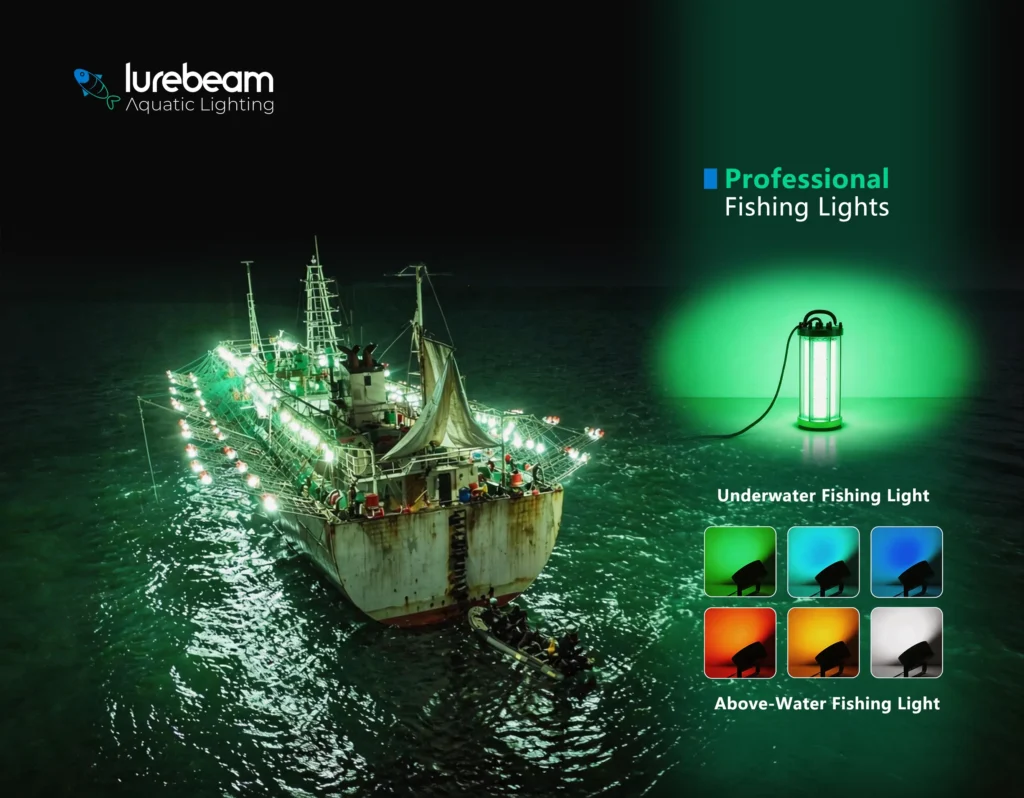
This is why commercial squid fishing operations may combine different lighting approaches, such as underwater fishing lights for squid attraction and powerful squid fishing boat lights for maintaining activity around the vessel.
How Commercial Squid Fishing Boats Use Underwater and Above-Water Fishing Lights
Scientific research explains why squid respond to light, but commercial squid fishing shows how this biological behavior is applied in real operations. Professional fishermen do not simply turn on powerful lamps and wait for squid to appear. Instead, they use different types of fishing lights at different stages to influence squid movement and create a more effective fishing environment.
Modern squid fishing operations are based on understanding how squid move vertically in the ocean at night. During the early stage of fishing, squid may still remain in deeper water layers. As the operation continues, fishermen gradually guide squid closer to the vessel by creating suitable light conditions.
Stage 1: Using Underwater Fishing Lights to Attract Squid from Deeper Water
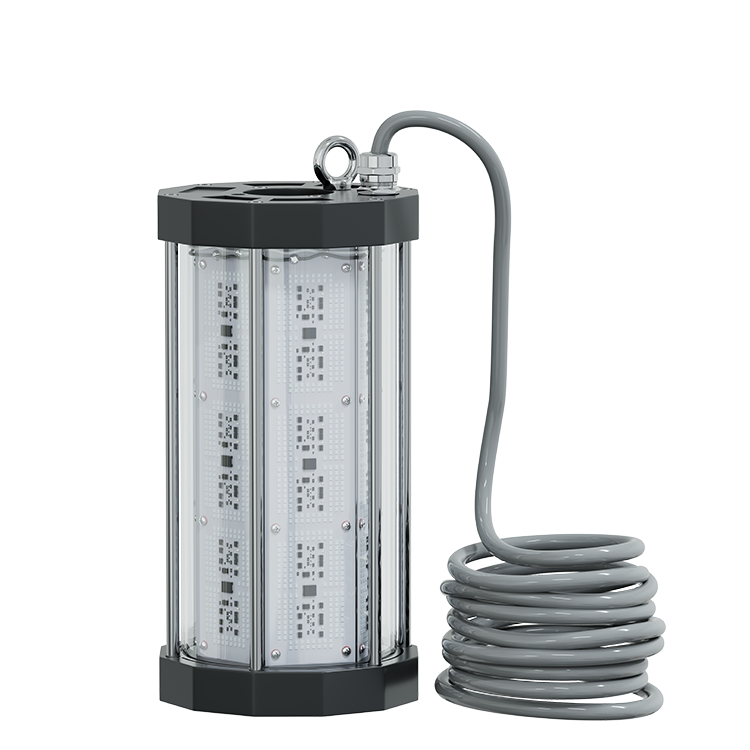
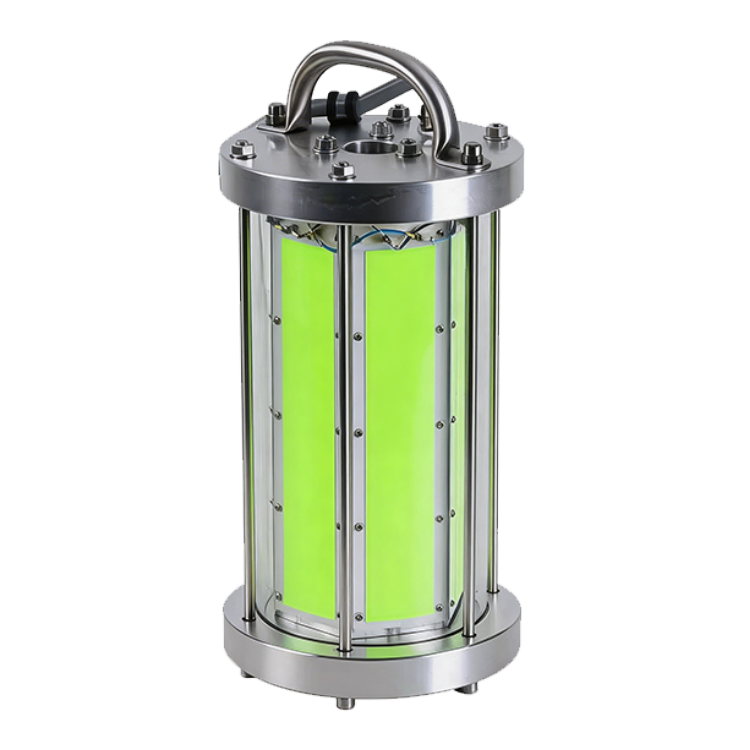
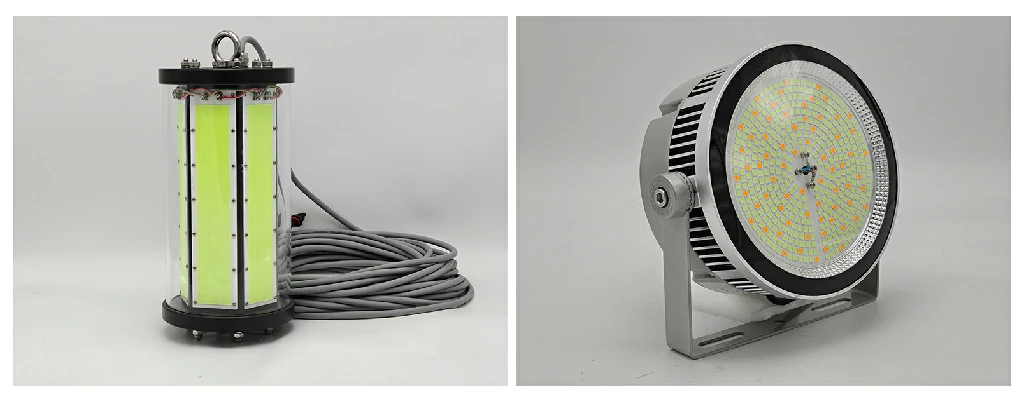
Underwater fishing lights for squid are increasingly used in modern fishing operations because they place the light source directly inside the water. Unlike surface lights, underwater lights reduce light loss caused by surface reflection and allow the light to reach the target water layer more efficiently.
At the beginning of a squid fishing operation, fishermen may deploy underwater LED fishing lights below the vessel. The purpose is not to illuminate the entire ocean, but to create a localized attraction zone where marine organisms begin to gather.
As plankton and small organisms gather around the light, small fish may follow. Squid, as active predators, naturally respond to this increase in potential food sources and move closer to the area.
This process explains why a fishing light for squid is not simply a “bright lamp.” It is a tool that uses natural biological behavior to influence squid distribution.
Stage 2: Using Squid Fishing Boat Lights to Maintain the Aggregation Area
After squid move closer to the fishing area, many commercial squid vessels use powerful above-water fishing lights installed on the boat. These squid fishing boat lights create a large-scale light field around the vessel and help maintain squid activity near the fishing zone.
Traditional squid fishing vessels often used metal halide lamps because they provided extremely high brightness. Today, many operators are gradually adopting LED squid fishing lights because of their lower energy consumption, longer lifespan, and better control over light spectrum.
The goal of these lights is not simply to make the area as bright as possible. In professional squid fishing, light distribution and the relationship between bright and dark areas are often more important than brightness alone.
Why Squid Often Stay Around the Light Boundary Area
One interesting behavior observed in squid fishing is that squid do not always stay directly under the brightest light. Instead, they often move around the boundary between strong light and darker water.
This behavior is related to their hunting strategy. Squid have highly sensitive eyes, and extremely bright environments may reduce their visual advantage. Areas with moderate light provide enough visibility while allowing them to observe prey movement more effectively.
For fishermen, this creates an opportunity to position fishing lines and squid jigs near these transition zones. The squid are attracted by the biological activity created by the light but may remain in areas where they feel more comfortable.
This is why experienced squid fishermen focus not only on the type of fishing light but also on how the entire light environment is created around the boat.
Combining Underwater and Above-Water Squid Fishing Lights
In modern commercial squid fishing, underwater fishing lights and above-water squid fishing boat lights are not necessarily competing solutions. In many cases, they serve different purposes and can work together as part of a complete fishing strategy.
Underwater lights are mainly used to deliver light into the water and influence squid movement in deeper areas. Above-water lights are mainly used to create a wider attraction field and maintain activity around the vessel.
The most effective squid fishing light system depends on many factors, including vessel size, fishing area, squid species, water depth, and local fishing experience.
Choosing the Right Light for Squid Fishing
Choosing the right squid fishing light is not simply about selecting the highest wattage or the brightest lamp. Professional fishermen understand that successful squid fishing depends on creating the right light environment for squid behavior. The most suitable lighting solution depends on the fishing area, target squid species, water depth, fishing method, and vessel conditions.
For this reason, experienced squid fishermen usually evaluate several factors before choosing a fishing light for squid, including wavelength, light distribution, installation position, and power output.
Light Spectrum: Choosing the Right Wavelength for Squid Behavior
Light wavelength is one of the most discussed factors in squid fishing. Research has shown that squid can respond differently to different LED wavelengths, but the best choice depends on the fishing environment rather than one fixed color.
Blue and cyan wavelengths are often considered important because squid visual pigments show strong sensitivity to shorter wavelengths, and these colors can travel efficiently through seawater.
Green light is also widely used in commercial fishing because it provides a practical balance between underwater visibility, attraction performance, and energy efficiency.
White light is commonly selected when fishermen need a wider and stronger light field around the vessel. It can provide high brightness and large-area coverage, which is why many traditional squid fishing boats use large numbers of white lamps.
The key point is that professional squid fishing does not depend on one “perfect” color. Instead, fishermen adjust the light spectrum according to local fishing experience and operating conditions.
Underwater Squid Fishing Lights vs Squid Fishing Boat Lights
Different fishing methods require different lighting strategies. Underwater fishing lights for squid and squid fishing boat lights both have important roles, but they create different types of attraction environments.
Underwater Fishing Lights for Squid
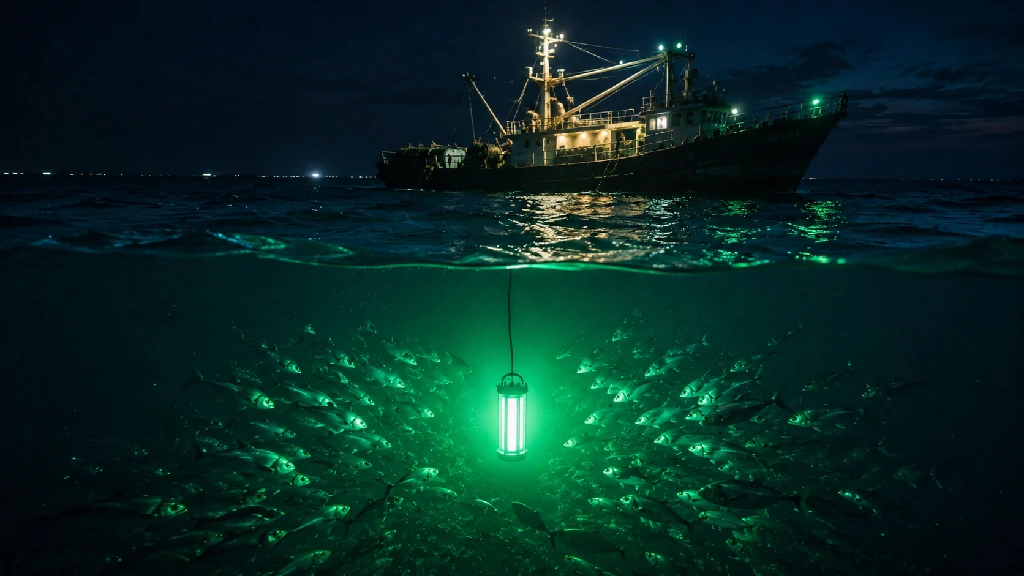
Underwater squid fishing lights place the light source directly inside the water. This allows the light to reach the target depth more efficiently and reduces energy loss caused by surface reflection.
They are especially useful when fishermen need to attract squid from deeper water layers or create a concentrated underwater attraction zone.
For modern LED squid fishing lights, underwater installation also provides better control over light direction and reduces unnecessary light exposure above the water surface.
Squid Fishing Boat Lights
Squid fishing boat lights are traditionally installed around the vessel to create a large-scale light field. They are widely used in commercial squid fishing because they can cover a wide area and maintain squid activity around the boat.
Large commercial squid vessels may use hundreds of lamps depending on vessel size, fishing method, and regional requirements. Modern LED systems are gradually replacing traditional metal halide lamps because they offer lower energy consumption, longer service life, and better control.

What Factors Should Be Considered When Choosing Squid Fishing Lights?
A professional squid fishing light system should be selected according to actual fishing requirements rather than only focusing on lamp specifications.
| Factor | Why It Matters |
|---|---|
| Target squid species | Different species may show different light responses |
| Fishing depth | Determines how much light penetration is needed |
| Installation method | Underwater and above-water lights create different effects |
| Vessel size | Determines required coverage area and power level |
| Fishing method | Different operations require different light strategies |
The right squid fishing light is the one that matches the fishing environment. A higher-power lamp does not always create better results if the light distribution, wavelength, or installation position is not suitable.
FAQ About Squid Fishing Lights
Research shows that squid can respond differently to different wavelengths, but there is no universal best color for every fishing condition. Blue, cyan, green, and white lights are all used in commercial squid fishing depending on the fishing environment and strategy.
Squid respond to artificial light because of their visual sensitivity and natural feeding behavior. Light attracts small organisms, which creates a feeding environment that encourages squid to approach.
Yes. Many commercial squid fishing operations are adopting LED technology because of its energy efficiency, durability, and adjustable light performance.
Yes. Underwater fishing lights for squid can place the light directly into the target water layer, helping create a concentrated attraction zone.
No. Different fishing areas, squid species, water depths, and fishing methods require different lighting solutions.
Conclusion: Light Is a Tool to Understand and Influence Squid Behavior
Squid fishing lights are not simply powerful lamps used to brighten the ocean. They are fishing tools based on marine biology, squid vision, and years of practical experience.
Scientific research on squid phototaxis helps us understand why squid respond to different wavelengths, while commercial fishing experience shows how to apply this knowledge in real operations.
From underwater fishing lights that attract squid from deeper water layers to squid fishing boat lights that maintain activity around vessels, modern LED technology continues to improve the efficiency and sustainability of squid fishing.
Understanding squid behavior is the foundation of choosing the right light for squid fishing.