-1-1024x1024.webp)

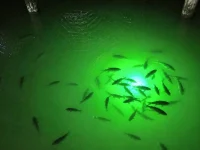
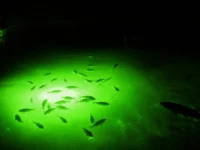
The pattern can be useful, but it is not a universal rule. Small schooling fish may gather inside an illuminated area, while larger predatory fish may patrol its transition into darker water. The reason is not simply that small fish “like light” and large fish “fear it.” A fishing light changes prey density, visibility and attack opportunities. Species, current, depth and water clarity can move—or erase—the apparent edge.
For an angler, the practical lesson is straightforward: do not automatically place every bait in the brightest water. Treat the light field as three zones, test the illuminated core, the light-dark transition and the darker water just beyond it, then repeat the test at the baitfish’s depth and slightly below it.
First, Correct the Premise: “Large Fish at the Edge” Is a Pattern, Not a Law
One relevant field study used imaging sonar to observe fish beside an illuminated estuarine structure for 110 hours. When the light was on, both small shoaling fish under 100 mm and large predators over 500 mm became more abundant in the illuminated area. Researchers observed large fish attacking shoals, but they did not establish that every predator remained on a precise light-dark boundary. The result shows that light can change prey concentration and predator foraging within the same area.
“Predators always stay outside the light” would contradict the evidence: they can enter illuminated water. The transition is simply a possible hunting position when it combines accessible prey with useful visual conditions.
A Fishing Light Creates a Gradient, Not a Hard Circle
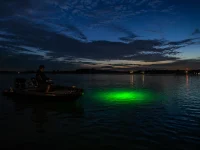
The surface glow may look like a bright disc with a sharp rim. Underwater, light fades as it travels and is absorbed or scattered. It also spreads vertically, so the important boundary may sit below the boat rather than at the ring visible on the surface.
It is more useful to divide the water into three functional zones:
- Illuminated core: the region receiving the most light from the device.
- Transition zone: the band where brightness and contrast change quickly.
- Surrounding water: the darker area beyond the useful light field.
These are observation zones, not fixed distances. The boundary can broaden in clear water, compress in turbid water, stretch down-current or lose contrast under moonlight and nearby lighting.
Why Baitfish May Gather in the Illuminated Zone
Small fish do not all respond identically. Depending on species and conditions, illuminated water may offer feeding opportunities, help fish maintain a shoal, or both. Some prey organisms respond to particular wavelengths, but not every plankton species is attracted to every fishing light.
A laboratory study of northern krill and Atlantic cod illustrates the difference. Krill were attracted to selected wavelengths, whereas the cod response was slightly repulsive but statistically non-significant. Researchers suggested that aggregated krill could be a stronger cue to cod than the lamp itself. A predator may therefore respond to prey around a light without being directly attracted to the source.
Light can also affect shoal structure. Experiments with juvenile walleye pollock found that cohesion weakened as illumination decreased and re-formed as light increased. This does not prove all baitfish pack into the brightest point, but it helps explain organised schools inside a usable light field.
Why a Predator May Use the Transition Zone
A predator needs more than prey nearby. It also needs a workable detection and attack opportunity. The transition between illuminated and darker water can provide both: prey may be concentrated or silhouetted on one side, while the predator can approach from a position with different background brightness.
This is a plausible mechanism, not a guarantee for every species. Controlled research on piscivorous salmonids found that prey-detection distance changed with illumination and differed among species; in one species, predation did not keep increasing with brighter light. Laboratory work on several marine fishes has likewise found species-specific changes in aggregation, movement, attraction and avoidance.
The brightest point is therefore not automatically best for every predator. A predator may cross the core, hold below the bait school, wait at a horizontal transition or ignore the aggregation. Position reflects sensory biology and hunting strategy—not body size alone.
The “Edge” Can Move With Current, Depth and Water Clarity
The most productive boundary is often not the surface ring visible from the boat.
Current: If small organisms and baitfish drift down-current, the feeding zone may become a plume. The useful transition can sit downstream of the lamp rather than around it as a symmetrical circle.
Depth: A bait school can occupy a bright layer while predators remain underneath it. In that case, lowering the presentation through the school may be more informative than casting farther away.
Turbidity: Suspended particles scatter and absorb light, shortening sight distances. A distance that worked in clear water should not become a rule for murky water.
Background light: Moonlight, dock lights and nearby vessels change the contrast between the illuminated area and its surroundings. With less contrast, a distinct edge-holding pattern may weaken or shift.
Use a Three-Zone Test to Find the Feeding Position
Instead of assuming where predators should be, use a controlled field test.
1. Establish the Light Field
Keep the light at one depth and setting. Note the current and locate the densest bait activity using surface movement, sonar or a camera if available. Mark the visible core and transition, remembering that their underwater positions may differ.
2. Test Position Without Changing Everything Else
Use the same bait or lure, similar retrieve or soak time, and the same starting depth. Make comparable presentations in three places: inside the illuminated core, through the transition zone and just outside it. In current, add a down-current pass through the drifting plume.
Then repeat the three positions at the baitfish’s depth and slightly below it. Change one variable at a time. If position, lure, speed and depth all change together, a strike reveals very little about which factor mattered.
3. Interpret Repeated Behaviour, Not One Strike
Use several comparable passes before calling a pattern:
| What you observe | What it may mean | What to test next |
|---|---|---|
| Bait is tight in the core; larger fish circle outside | The transition may be an attack route | Run the presentation along the boundary and slightly below the bait |
| Bait drifts consistently down-current | The feeding zone may be a plume | Follow the downstream edge instead of the surface circle |
| Predators repeatedly cross the bright core | They are not avoiding the illuminated zone | Present along their travel path rather than forcing an edge theory |
| Bait is spread evenly with no clear aggregation | Light may not be the main positioning factor | Test depth, current break or nearby structure |
| Fish follow but do not strike | Attraction and capture are different stages | Keep the location result, then test bait depth, size or retrieve separately |
This method does not promise a catch. It prevents an angler from spending the whole session at one visually obvious position without testing it.
Common Interpretation Errors
Do not call every large sonar mark a predator; size is not proof of feeding role. Do not treat surface glow as the entire light field. Avoid changing brightness, depth, lure and position after every cast, because the result becomes impossible to interpret. Absence from the brightest water also does not prove fish are “scared of the light”; they may be below the school, downstream or responding to another habitat feature.
Conclusion
Small baitfish may gather in illuminated water because light can affect prey availability and shoal cohesion. Predators may use the transition because it can combine concentrated prey with workable attack conditions. Neither position is universal, and body size is not the underlying rule.
The reliable approach is to map the core, transition and surrounding water, then test horizontal position and depth separately. The edge is a hypothesis. Repeated fish behaviour is the evidence.
Frequently Asked Questions
Should I cast into the brightest part of a fishing light?
Test it, but do not fish there exclusively. If baitfish occupy the core, predators may enter it, patrol its transition or hold below the school. Compare equal presentations in all three zones before choosing a position.
How far outside the light should I fish?
There is no universal distance. Water clarity, lamp placement, current and background light alter the gradient. Use the visible transition only as a starting reference, then move the presentation in measured steps while keeping depth and lure action consistent.
Are the larger fish always below the baitfish?
No. Holding below a school is one possible attack position, but predators may also approach horizontally, pass through the school or use structure and current. Sonar or repeated presentation tests are more reliable than assuming a fixed vertical arrangement.
Does green light always pull baitfish into the center?
No. Responses depend on species, wavelength, intensity, water conditions and available prey. Research supports species-specific reactions, not a universal rule that every baitfish must occupy the centre of every green light field.