-1-1024x1024.webp)
-1024x1024.webp)
Yes. For some fish and under some conditions, increasing intensity can change attraction into avoidance. A laboratory study of juvenile Chinook and coho salmon, for example, found that both species avoided a full-intensity mercury-vapour light, while Chinook salmon were attracted to the dim version. That does not establish a setting for modern LED fishing lights or for other species. It does establish the important point that “brighter” and “more attractive” are not the same biological response.
The useful target is a light field that contains an intensity band the fish will occupy—not the brightest possible spot. Three rules follow. Do not judge the light by electrical wattage alone. Do not assume that fish circling outside the bright centre means the light has failed. Call a light “too bright” only when a controlled change in intensity produces a repeatable outward movement, dispersal or avoidance that reverses when the original setting is restored.
What Does “Too Bright” Actually Mean?
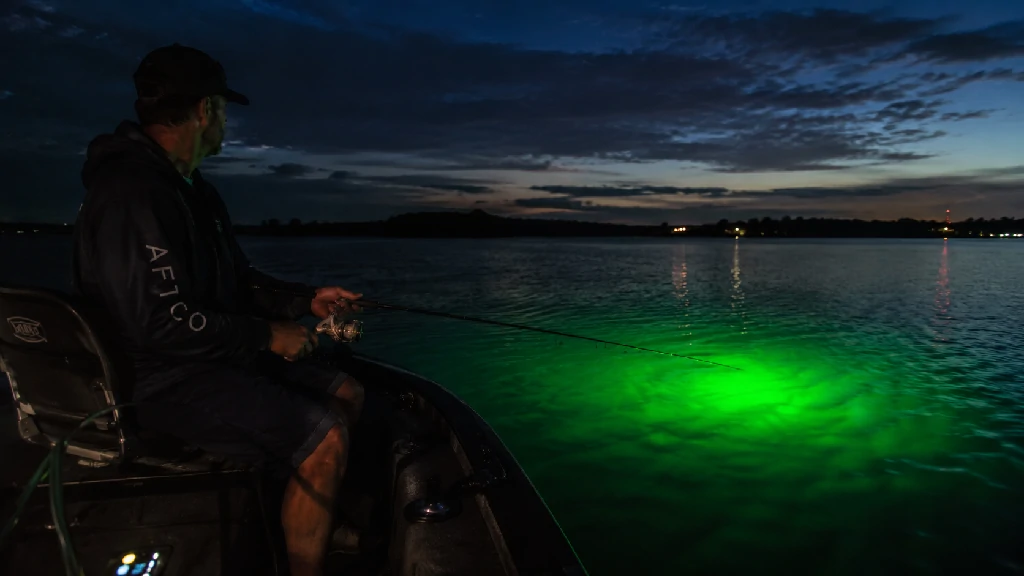
In everyday language, brightness is what a person sees. For fish attraction, the operational question is different: how much optical radiation of each wavelength reaches the animal at its position, against the existing background light? A light is too intense for the task when its light field makes the desired fish or prey organisms occupy a less useful area, disperse, hide or avoid the source compared with a lower exposure under otherwise similar conditions.
That definition is deliberately conditional. Fish species have different visual systems and behaviours; life stage, dark adaptation, background light and the way intensity changes can also matter. In laboratory tests covering 0.2–68 μE s⁻¹ m⁻², European seabass, common grey mullet, gilthead seabream and striped bream did not respond alike. The researchers found that both absolute intensity and the sequence in which intensity was raised or lowered affected behaviour. Their results support species-specific lighting decisions, not a universal “maximum brightness.”
Fish Often Hold in an Intensity Band, Not at the Lamp
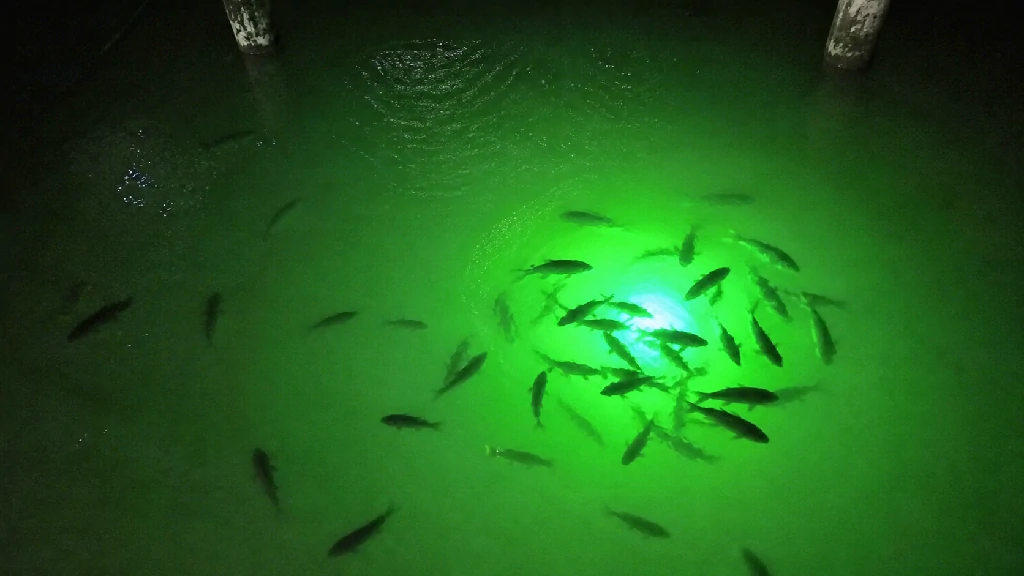
A field study of Japanese anchovy provides a particularly useful picture. Researchers used sonar to map schools around an underwater LED lamp and a halogen lamp, then compared fish positions with the measured spectral irradiance fields. The two lamp types produced different underwater distributions, yet the schools that remained around them followed similar contours when the light was weighted for anchovy visual sensitivity. The fish occupied a band some distance from the fixtures rather than simply crowding the highest-output point.
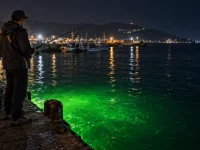
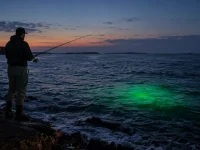
The authors described this as evidence suggesting a suitable illuminance range for that species, while also stating that more data were needed to define it clearly. This limitation matters: the result belongs to Japanese anchovy, the tested lamps and that fishery. It is not a universal lux chart. Its practical value is the geometry it reveals. A compact school circling the edge of a light field may be using a preferred intensity contour. Moving your bait to that boundary can be more rational than trying to force the fish into the centre with still more power.
Why Watts, Lumens and Surface Appearance Can Mislead You
Watts describe a rate of energy use or transfer. On a fishing-light label, the figure normally refers to electrical input, not the irradiance reaching a fish. Efficiency, beam distribution and housing losses can make equal-wattage lamps create different underwater fields.
Lumens and lux answer a different question. The U.S. National Institute of Standards and Technology explains that these photometric quantities are weighted to human-eye response. They can compare repeated measurements made with the same spectrum and geometry, but do not directly measure how every fish species sees a lamp. Fisheries studies may instead report spectral irradiance, photon irradiance or a species-weighted quantity.
Water then reshapes the field. Distance reduces exposure, while dissolved material and suspended particles absorb and scatter light. NOAA describes the diffuse attenuation coefficient as a wavelength-specific measure of this reduction; higher attenuation means less penetration. A lamp that looks dazzling beside the boat may therefore produce much lower exposure where the fish are. The relevant field is at the animal, not at the angler’s eyes.
Is the Light Too Bright, or Are Fish Using the Light Boundary?
Fish staying away from the fixture is not enough to diagnose excessive intensity. Use the pattern of change:
- Consistent boundary use: The school remains cohesive and repeatedly follows a similar ring, depth or down-current boundary. This is compatible with a preferred intensity band; fish the boundary first.
- Repeatable outward displacement: When output increases, an already-present school moves farther away, becomes less cohesive or leaves; when the original output returns, the previous distribution returns. This is practical evidence that the higher exposure is less attractive in that setup.
- No fish anywhere in the field: This does not identify excessive brightness. Fish may be absent, outside detection range or responding to prey, current, temperature, oxygen, predators or background light.
- Fish gather but do not bite: This shows that attraction and capture are different stages. Tackle, bait depth and predator position may be the limiting factors, not intensity.
These are field inferences, not species-specific laboratory thresholds. Their strength comes from observing a reversible response while controlling other variables.
Use an A–B–A Test Instead of Guessing
If the light has a manufacturer-approved output control, you can test the question without inventing a “correct” setting.
First, wait until bait or fish are already detected and their position is reasonably stable. Record the original setting and the school’s distance, depth and cohesion: this is condition A. Increase output by one available step while keeping light colour, lamp position, fishing location, bait presentation and other controllable factors unchanged: this is condition B. Then return to the original setting: condition A again.
The test supports a “too bright” diagnosis only if the outward or avoidance response appears at B and the earlier distribution returns at A. A single movement is weak evidence because the school could be following prey or current. Catch count alone is also a poor response variable: hook placement and feeding behaviour can change catch without changing aggregation.
With a fixed-output lamp, changing models is not a clean test because spectrum and beam shape may also change. Treat the school’s stable boundary as the fishable zone rather than claiming an excessive setting. For future flexibility, stepped or dimmable output is more informative than maximum wattage—provided the control is approved for the fixture.
What Should You Change When Higher Output Causes Avoidance?
Return to the lower approved setting and confirm that the school reforms. Put the bait or lure in the occupied intensity band, not automatically beside the fixture. Follow the product’s deployment instructions and keep cables, propellers and fishing lines separated.
Do not cover the lamp, alter its driver or add an improvised dimmer; use approved controls. If the lower setting does not restore the school, reassess fish presence, prey movement, current and target depth instead of continuing to blame brightness.
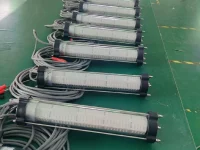
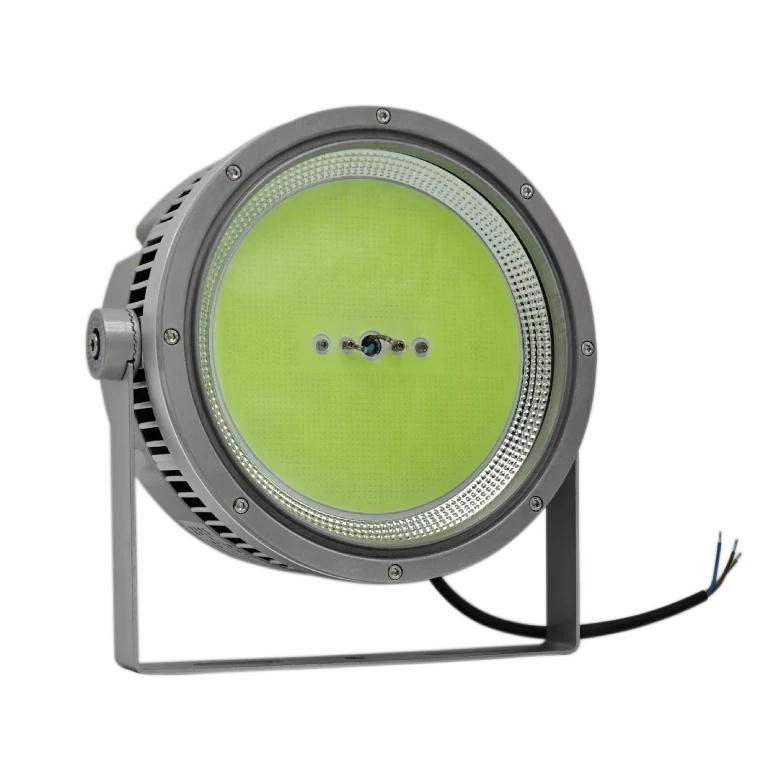
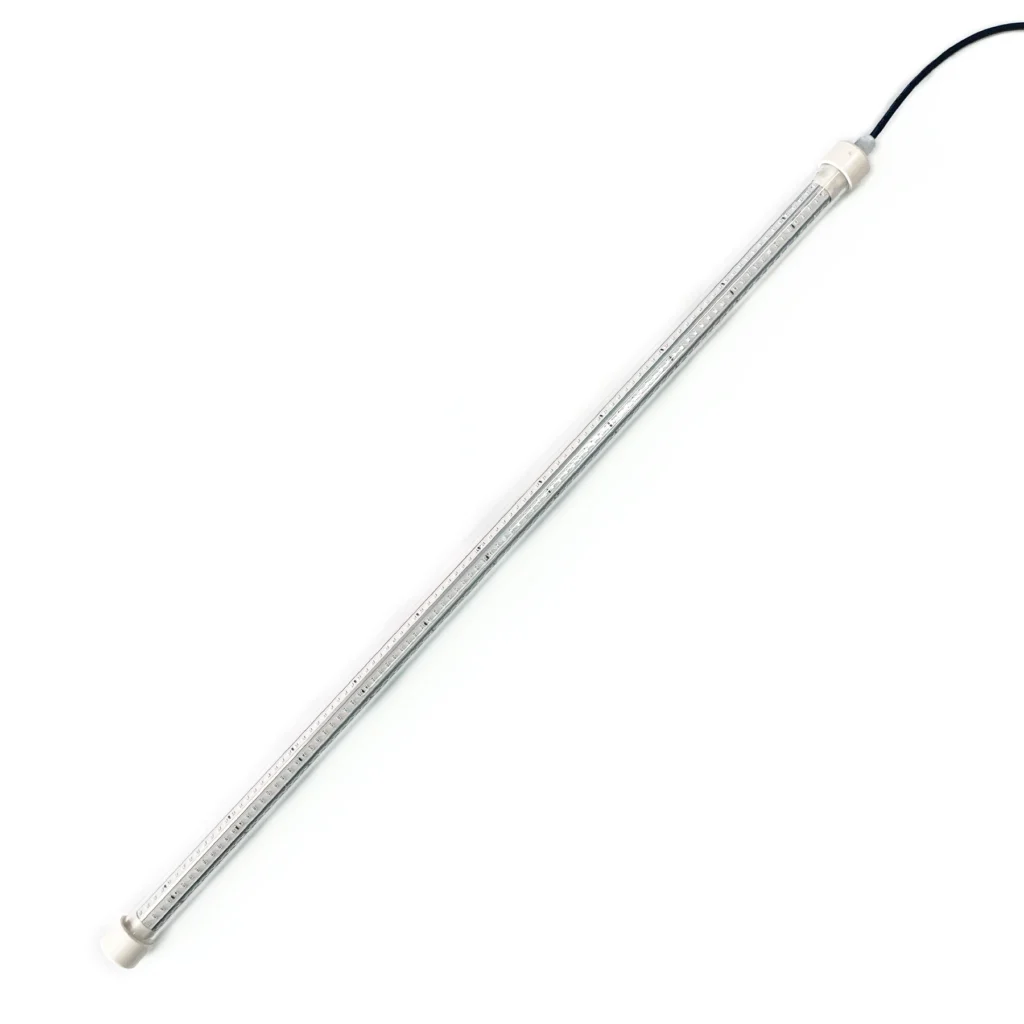
When comparing equipment, ask for the spectrum, angular distribution and measurements at stated distances in water—not just input watts. An underwater field map is more informative than a photograph of a glowing lamp. Specifications describe the field; fish behaviour shows whether it fits the situation.
Conclusion
An underwater fishing light can be too intense for a particular fish, life stage and set of conditions. Research does not support one universal watt, lumen or lux ceiling; it supports the idea of species- and context-dependent intensity bands. The practical answer is therefore observable: fish the stable boundary, and use a reversible A–B–A output test before blaming brightness. If higher output repeatedly pushes an established school outward and the lower setting brings it back, more light is not helping that setup.
Frequently Asked Questions
Does a brighter underwater fishing light attract fish from farther away?
Not automatically. More output can enlarge parts of the detectable light field, but attenuation, beam distribution and fish response prevent a simple proportional relationship. A larger field is useful only if it includes intensities the relevant organisms approach and remain within.
Is a ring of fish around the light proof that the centre is too bright?
No. Japanese anchovy field observations showed schools following intensity contours around underwater lamps, which is consistent with use of a preferred band. Proof of excessive intensity requires a repeatable outward shift when output rises and a return when it falls.
Can I compare two fishing lights by lumens?
Lumens can describe human-weighted visible output, but they do not include underwater attenuation, angular distribution or species-specific vision. They are insufficient on their own. Compare electrical input, spectrum, distribution and stated in-water measurements, then verify the result through fish position.
Should I install a dimmer on a fixed-output fishing light?
Only if the manufacturer identifies a compatible control method. An improvised dimmer may not match the driver and can compromise operation or protection. If output control matters, select a system designed with that function.
Does murky water always mean I need more power?
No. Suspended and dissolved material can increase absorption and scattering, so extra output may mainly brighten nearby water instead of extending the useful field proportionally. Confirm fish depth and the occupied light boundary before changing power.